
Table of Contents
- What Is a Good Business Loan APR and How Does It Actually Work?
- The Definition of Business Loan APR vs. Interest Rate
- Why APR Is the Only Number That Matters for Your Bottom Line
- Average Business Loan APR Benchmarks by Lender Type
- How Lenders Calculate Your Business Loan APR
- The Role of Your Credit Score and Time in Business
- Collateral Requirements and Their Impact on Your Rate
- Fixed vs. Variable APRs: Choosing the Right Risk Level
- The Hidden Costs: Fees That Inflate Your Total APR
- Common Origination and Underwriting Fees
- Prepayment Penalties and Late Payment Structures
- The Real Cost of "Factor Rates" in Merchant Cash Advances
- Comparing Business Loan APRs Across Different Products
- SBA Loans: The Gold Standard for Low APRs
- Traditional Bank Loans vs. Online Alternative Lenders
- Equipment Financing and Business Lines of Credit
- Real-World Examples: The Total Cost of Borrowing $50,000
- Scenario A: Low-APR SBA Loan over 10 Years
- Scenario B: Mid-Range Online Term Loan over 3 Years
- Scenario C: High-APR Short-Term Bridge Loan
- How to Lower Your Business Loan APR Before You Apply
- Strategies to Boost Your Business Credit Profile
- The Importance of Debt-Service Coverage Ratio (DSCR)
- Alternatives to High-APR Business Loans
- Invoice Factoring and Bootstrapping
- Personal Solutions for Small Needs
- Common Myths and Mistakes About Business Loan APRs
- Myth: The Lowest Interest Rate Is Always the Best Deal
- FAQ: Can I Refinance a High-APR Business Loan Later?
Navigating the maze of business financing can feel overwhelming when you’re trying to distinguish a competitive offer from a debt trap that could stifle your company’s growth. In this guide, we’ll break down exactly how to calculate the true annual percentage rate (APR) of any loan—including those hidden fees lenders often bury in the fine print—so you can compare offers with total confidence. Our analysis is based on the latest 2026 market benchmarks and expert underwriting standards to ensure you secure the most cost-effective capital available for your business.
What Is a Good Business Loan APR and How Does It Actually Work?
In the current U.S. market, a “good” business loan APR typically ranges from 6% to 12% for prime borrowers. However, the definition of “good” is highly subjective and depends on the specific loan product. For a Small Business Administration (SBA) loan, you should expect an APR near the lower end of that range, whereas a specialized online term loan might be considered competitive at 15% to 25%. The primary goal is to ensure the cost of capital is significantly lower than the return on investment (ROI) the funds will generate for your company.
The Definition of Business Loan APR vs. Interest Rate
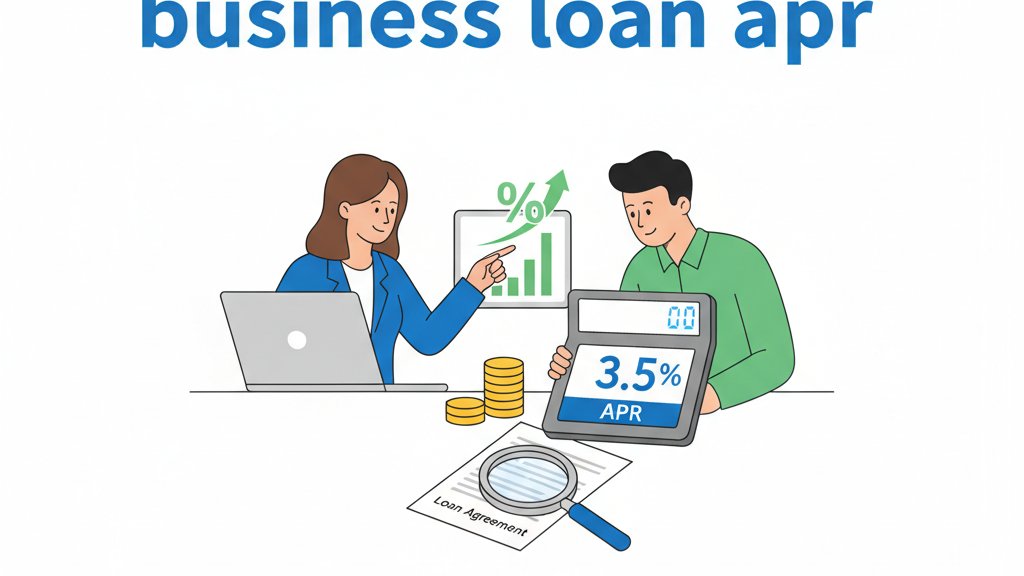
Many business owners make the mistake of looking only at the “nominal interest rate.” The interest rate is simply the cost of borrowing the principal balance, but it doesn’t tell the whole story. The business loan apr is a more comprehensive figure that includes both the interest rate and any mandatory fees, such as origination fees, processing costs, and documentation charges. If a lender offers you a 7% interest rate but charges a 5% origination fee, your APR will be significantly higher than the advertised rate. Much like comparing simple energy reviews to find the best utility rates, comparing APRs ensures you aren’t overpaying for essential services.
Why APR Is the Only Number That Matters for Your Bottom Line
APR is the “great equalizer” in financial comparisons. Because different lenders use different terminology—some charge “factor rates,” others charge “monthly service fees”—comparing them head-to-head is nearly impossible without a standardized metric. By converting every offer into an APR, you can see the true annualized cost of the capital. This prevents you from accidentally choosing a loan that appears cheaper on a monthly basis but actually costs more over the life of the loan due to front-loaded fees.
Average Business Loan APR Benchmarks by Lender Type
To give you a baseline for your search, traditional commercial banks currently offer APRs between 6% and 11%. SBA 7(a) loans usually hover around the Prime Rate plus a markup of 2.25% to 4.75%. On the other end of the spectrum, online alternative lenders provide faster funding but at a higher cost, with APRs ranging from 15% to 80% or more for high-risk products like Merchant Cash Advances (MCAs). Knowing these benchmarks helps you immediately identify if an offer is within the fair market range for your credit profile.
How Lenders Calculate Your Business Loan APR
Lenders don’t pull these numbers out of thin air; they use a risk-based pricing model. The riskier they perceive your business to be, the higher the APR they will charge to offset potential losses. They look at your “Five C’s of Credit”: Character, Capacity, Capital, Collateral, and Conditions. In the U.S., lenders also heavily weigh your debt-to-income ratio and your business’s historical cash flow to determine if you can comfortably afford the total cost of the loan.
The Role of Your Credit Score and Time in Business
Your personal FICO score remains a critical factor for most small business loans. A score above 720 typically unlocks the lowest APRs at major banks like Chase or Wells Fargo. Before applying, it is wise to check my uc credit report to ensure there are no errors that could negatively impact your eligibility. Additionally, “Time in Business” is a major hurdle; companies with less than two years of operational history are viewed as higher risk. If you are a startup, expect your business loan apr to be at least 5-10 percentage points higher than an established firm with a five-year track record of profitability.
Collateral Requirements and Their Impact on Your Rate
Secured loans—those backed by real estate, equipment, or inventory—almost always carry lower APRs than unsecured loans. By providing collateral, you reduce the lender’s risk, which they reward with a lower rate. For example, an unsecured line of credit might carry an APR of 18%, while a loan secured by a commercial property could drop that rate to 7%. If you have assets to leverage, always mention them early in the application process to drive that APR down. This logic applies to other secured financing as well, such as a mogo auto loan where the vehicle serves as the underlying security for the debt.
Fixed vs. Variable APRs: Choosing the Right Risk Level
A fixed APR stays the same for the duration of the loan, providing predictable monthly payments that are ideal for long-term budgeting. A variable APR is usually tied to an index like the London Interbank Offered Rate (LIBOR) or the U.S. Prime Rate. While variable rates often start lower than fixed rates, they carry the risk of increasing if the Federal Reserve raises interest rates. For short-term needs (under 12 months), a variable rate might save you money, but for a 5-year term, the security of a fixed APR is often worth the slight premium.
The Hidden Costs: Fees That Inflate Your Total APR
To truly understand your business loan apr, you must look beyond the interest. Fees are where many “low-interest” loans become expensive. Always ask for a Closing Disclosure or a Truth in Lending statement that explicitly lists every one-time and recurring charge. If a lender is hesitant to provide an APR calculation, it’s a red flag that the fee structure may be predatory.
Important: Always calculate the “Effective APR” yourself if the lender only provides a daily or monthly rate. A small 1% monthly fee actually equates to a 12.68% APR when compounded.
Common Origination and Underwriting Fees
The origination fee is the most common “hidden” cost, typically ranging from 1% to 6% of the total loan amount. It is usually deducted from the proceeds before you receive the funds. If you borrow $100,000 with a 5% origination fee, you only receive $95,000 in your bank account, yet you are responsible for paying back the full $100,000 plus interest. This “missing” $5,000 must be factored into your APR calculation to see the real cost of the capital you actually get to use. Managing these costs is as vital as finding affordable insurance companies to keep your overhead manageable.
Prepayment Penalties and Late Payment Structures
Some lenders charge a fee if you pay off your loan early. Why? Because they lose out on the interest they expected to earn over the full term. This is particularly common with high-interest online lenders. Additionally, check the late payment structure. While a $35 late fee might seem small, some business lenders charge a percentage of the remaining balance or a “daily penalty,” which can cause your effective APR to skyrocket if you hit a cash flow hiccup.
The Real Cost of “Factor Rates” in Merchant Cash Advances
Merchant Cash Advances (MCAs) don’t use APRs; they use “factor rates” (e.g., 1.25). This sounds low, but it is not an annual rate. A 1.25 factor rate means you pay back $1.25 for every $1.00 borrowed. If you pay this back over 6 months through daily sales deductions, the equivalent APR can exceed 100%. Always convert a factor rate to an APR before signing; simply multiply the total cost by the number of times the repayment period fits into a year to see the staggering difference.
Example: Borrowing $10,000 at a 1.30 factor rate with 6-month repayment = $13,000 total repayment. This represents a $3,000 cost for a 6-month term, which equates to an approximate APR of 60% to 90% depending on the daily payment structure.
Comparing Business Loan APRs Across Different Products
Choosing the right loan product is just as important as choosing the right lender. Each financial instrument is designed for a specific purpose, and using the wrong one can lead to unnecessary expenses. For example, using a high-interest credit card for a long-term expansion project is far more expensive than a dedicated term loan.
| Loan Type | Typical APR Range | Common Fees | Best For |
|---|---|---|---|
| SBA 7(a) Loans | 6.5% – 12% | Guarantee Fee, Packaging Fee | Long-term growth, Real Estate |
| Conventional Bank Loan | 7% – 12% | Origination, Appraisal | Established businesses with collateral |
| Online Term Loan | 11% – 35% | Origination, Monthly Maintenance | Fast working capital (24-48 hours) |
| Merchant Cash Advance | 40% – 100%+ | Factor Rate, Closing Fee | Emergency cash with poor credit |
SBA Loans: The Gold Standard for Low APRs
The U.S. Small Business Administration guarantees a portion of loans made by partner banks, which allows those banks to offer some of the lowest APRs in the market. The SBA 7(a) and 504 programs are excellent for real estate and long-term working capital. While the application process can take 30 to 90 days, the savings in APR—often 10% to 20% lower than online alternatives—make it the best choice for patient, qualified borrowers.
Traditional Bank Loans vs. Online Alternative Lenders
Traditional banks like Bank of America or local credit unions offer the best rates but have strict requirements, often demanding a 680+ credit score and consistent profitability. Online lenders like OnDeck or BlueVine prioritize speed and ease of access. You can often get funded within 24 hours, but you pay for that convenience with APRs that are typically 10% to 30% higher than traditional bank offerings.
Equipment Financing and Business Lines of Credit
Equipment financing uses the machinery or vehicle itself as collateral, which naturally keeps the APR lower (typically 8% to 20%). A Business Line of Credit is more flexible; you only pay interest on the amount you draw. This is perfect for managing seasonal cash flow. However, be wary of “maintenance fees” or “draw fees” that can add 1-2% to your effective APR even if you aren’t using the full credit line.
Real-World Examples: The Total Cost of Borrowing $50,000
Let’s look at how the same $50,000 loan can cost vastly different amounts depending on the APR and terms. These examples assume the loan is fully amortized over the stated period.
Scenario A: Low-APR SBA Loan over 10 Years
If you secure an SBA loan at a 9% APR for 10 years, your monthly payment would be approximately $633. Over the life of the loan, you would pay back a total of $76,000. The cost of borrowing $50,000 is $26,000 spread over a decade. This is highly manageable for most growing businesses.
Scenario B: Mid-Range Online Term Loan over 3 Years
An online lender might offer $50,000 at a 18% APR for 3 years. Your monthly payment jumps to $1,808. In just 36 months, you will have repaid $65,088. While the total interest ($15,088) is lower than the 10-year loan, the monthly cash flow strain is nearly three times higher. This highlights why you must balance APR with the “term” of the loan.
Scenario C: High-APR Short-Term Bridge Loan
A short-term “bridge” loan or MCA might charge a 45% APR with a 12-month term. You would pay roughly $5,200 per month, totaling $62,400 in just one year. You are paying $12,400 for the privilege of using $50,000 for only 12 months. This is only advisable if the capital will generate an immediate profit that far exceeds the $12,400 cost.
How to Lower Your Business Loan APR Before You Apply
You are not stuck with the first rate you are offered. Much like a mortgage, business loan terms are often negotiable if you come to the table prepared. The goal is to prove to the lender that you are a “low-risk” bet. Actionable step: Download your business credit report from Dun & Bradstreet or Experian Business at least three months before applying to check for errors.
- Audit your credit: Dispute inaccuracies on your Experian Business or Equifax reports.
- Reduce existing balances: Lowering your credit utilization can bump your score by 20-30 points quickly.
- Prepare a “Use of Funds” statement: Lenders offer better rates when they know exactly how the money will generate revenue.
- Gather two years of tax returns: Proven profitability is the #1 way to secure a sub-10% APR.
Strategies to Boost Your Business Credit Profile
To secure a lower APR, ensure your business has its own credit identity separate from your personal FICO score. Pay your vendors early (not just on time), as many report to business credit bureaus. Reducing your credit utilization ratio on existing business cards—aim for under 30%—can trigger a rapid increase in your score, potentially qualifying you for a tier-one interest rate that saves you thousands in APR.
The Importance of Debt-Service Coverage Ratio (DSCR)
Lenders calculate your DSCR by dividing your annual net operating income by your annual debt payments. A ratio of 1.25 or higher is the “sweet spot.” If your ratio is lower, lenders will hike your APR to cover the risk of a potential default. To improve this before applying, try to pay down small high-interest debts or find ways to increase your net income by cutting non-essential overhead expenses.
Alternatives to High-APR Business Loans
Before committing to a high-APR loan, consider if there are “cheaper” ways to find capital. Sometimes the best loan is the one you don’t take. If your business is in a temporary cash crunch, look for internal solutions first.
- Business Grants: Non-repayable funds from organizations like the SBA, Grants.gov, or private corporations (e.g., FedEx Small Business Grant).
- Equity Financing: Raising capital from Angel Investors in exchange for equity—zero interest, but loss of some control.
- Internal Cash Flow: Delaying non-critical capital expenditures to prioritize immediate working capital needs.
- Asset Liquidation: Selling unused equipment or slow-moving inventory to inject cash without taking on debt.
Invoice Factoring and Bootstrapping
If your cash is tied up in unpaid customer invoices, invoice factoring allows you to “sell” those invoices for an immediate cash advance (usually 80-90% of the value). The fee is typically 1-3% per month. While this can have a high effective APR, it is often easier to qualify for than a bank loan. Alternatively, “bootstrapping”—reinvesting every penny of profit back into the business—is the only way to grow with a true 0% APR.
Personal Solutions for Small Needs
For very small capital needs (under $10,000), a personal loan from a friend or family member with a formal promissory note can be a lifesaver. You might also consider selling underutilized equipment or inventory to raise quick cash. If you are struggling with existing debt, contact debt relief programs or a non-profit debt counseling service like the NFCC (National Foundation for Credit Counseling) before taking out a new loan to “consolidate” old ones, as this often leads to a higher total APR.
Common Myths and Mistakes About Business Loan APRs
There is a lot of misinformation in the commercial lending space. One common myth is that “APR doesn’t matter for short-term loans.” This is false. Even if you only need money for three months, the APR tells you the cost of that money relative to other options. If a 3-month loan has a 100% APR, it is objectively expensive, regardless of how quickly you pay it back.
Myth: The Lowest Interest Rate Is Always the Best Deal
As we’ve discussed, a low interest rate can hide a high APR. A 5% interest rate loan with a $5,000 “administrative fee” can be more expensive than an 8% interest rate loan with no fees. Always ask: “What is the total amount I will pay back, including everything?” If the lender won’t give you a straight answer, walk away.
FAQ: Can I Refinance a High-APR Business Loan Later?
Yes, and you should. If you took out a high-APR “bridge loan” to get through a crisis, you should look to refinance it with a lower-cost SBA or bank loan as soon as your financial situation stabilizes. This is a common strategy for savvy business owners: use expensive, fast capital to seize an opportunity, then replace it with “cheap” long-term capital once the risk has decreased. Just as you might look for a better savings account interest rate to maximize your returns, refinancing helps you minimize your costs.
Before you sign any loan agreement, always insist on seeing the total APR rather than just a monthly payment or factor rate so you can compare the true cost of capital across different lenders. Your next step should be to calculate your business’s debt-service coverage ratio and pull your credit reports to ensure you’re positioned to negotiate for the lowest rates available in the current market.
Read more about related topics
- Spectrum Internet Reviews: Real Customer Experiences and Ratings
- Whole Life Insurance: Your Complete Guide to Lifelong Coverage
- Con Edison Reviews: Real Customer Experiences and Service Ratings
- Elskling Reviews: Real Customer Experiences with This Baby Brand
- Debt Free Money Bank: How to Build Wealth Without Borrowing

This is a super helpful breakdown, especially the distinction between APR and the nominal interest rate. I was comparing a few online lenders last month and the APR was definitely the figure that made me pause and re-evaluate. It’s so easy to get blinded by what seems like a lower monthly payment without seeing the full picture.
Really appreciate the focus on the 2026 market benchmarks – gives me some solid targets to aim for. I’m curious, how much does the industry you’re in typically affect the APR you can expect? My business is in a slightly more niche sector, and I wonder if that plays a big role in underwriting standards.
Great question, Sarah! Industry risk absolutely plays a role. Lenders assess the volatility and profitability of different sectors when setting APRs. Generally, more stable industries might see slightly lower rates than those with higher inherent risk. It’s always worth discussing this with potential lenders.