


Table of Contents
- The Step-by-Step Roadmap to Buying a Reliable Used Car
- Determine Your Budget and Maximum Out-of-Pocket Cost
- Researching the Right Make, Model, and Year for Your Needs
- Where to Look: Private Sellers vs. Dealerships vs. Online Platforms
- Calculating the Real Costs: Beyond the Sticker Price
- Understanding Dealer Fees, Sales Tax, and Registration Costs
- The Hidden Impact of Interest Rates on Your Monthly Payment
- Factoring in Post-Purchase Costs: Insurance, Maintenance, and Fuel
- How to Inspect and Verify a Used Vehicle Like a Pro
- The Essential Pre-Purchase Inspection (PPI) Checklist
- Decoding the Vehicle History Report: Carfax and AutoCheck
- Financing Your Purchase: Finding the Best Rates
- Comparing Credit Union Loans, Bank Financing, and Dealer Credit
- Smart Alternatives to Traditional Car Loans
- Common Used Car Myths and Mistakes to Avoid
- Myth: Low Mileage Always Means a Better Vehicle
- The Mistake of Monthly Payment Shopping Instead of Total Price
- FAQ: How Do I Spot a Flood-Damaged or Salvage Title Vehicle?
Navigating the used car market can feel like a high-stakes gamble, especially when you are trying to balance reliability with a price tag that won’t wreck your monthly budget. In this guide, we will break down the entire process from calculating the true cost of ownership to mastering the art of the pre-purchase inspection, ensuring you drive away with a deal you actually feel good about. Our advice is rooted in the latest market trends and rigorous financial analysis from our team of experts, giving you the edge you need to shop with confidence.
The Step-by-Step Roadmap to Buying a Reliable Used Car
Buying a used vehicle in the United States requires a systematic approach to avoid “lemons” and predatory financing. The primary goal is to secure a vehicle that provides a lower total cost of ownership than a new car, which loses roughly 20% of its value in the first year alone. Even if you are looking for summer jobs 2018 style temporary work, having reliable transportation is key. To succeed, you must first establish your “out-the-door” price—the total amount including taxes and fees—rather than just the sticker price you see on the window.
- Assess your total liquid savings and monthly surplus.
- Research reliable models with low 5-year maintenance costs.
- Get pre-approved for a loan through a credit union.
- Locate vehicles and verify their VIN history.
- Perform a physical inspection and professional PPI.
- Negotiate the final price and sign the title.
Determine Your Budget and Maximum Out-of-Pocket Cost
Financial experts generally recommend the 20/4/10 rule: put down at least 20%, finance for no more than 4 years (48 months), and keep your total monthly transportation costs (including insurance and fuel) under 10% of your take-home pay. Learning how to save money as a college student can help you build this down payment faster. In the current U.S. market, where used car prices have stabilized after record highs, having a clear ceiling prevents you from being upsold into a luxury trim that stretches your debt-to-income ratio too thin.
Researching the Right Make, Model, and Year for Your Needs
Reliability varies significantly across brands and even specific model years. Use resources like Consumer Reports or J.D. Power to identify vehicles known for longevity, such as the Toyota Camry or Honda CR-V. Focus on “sweet spot” vehicles: those that are 3 to 5 years old. These cars have already undergone their steepest depreciation curve but often still feature modern safety technology and potentially some remaining powertrain warranty.
Where to Look: Private Sellers vs. Dealerships vs. Online Platforms
You have three main avenues for your search. Private sellers (found on platforms like Facebook Marketplace or Craigslist) often offer the lowest prices because they lack overhead, but you have zero consumer protection once the title is signed. Franchise dealerships offer Certified Pre-Owned (CPO) programs which provide peace of mind through multi-point inspections and extended warranties, though you will pay a premium of $1,000 to $3,000 for this. Online “vending machine” retailers like Carvana or Vroom offer fixed pricing and convenience, but their financing rates can sometimes be higher than local credit unions.
Calculating the Real Costs: Beyond the Sticker Price
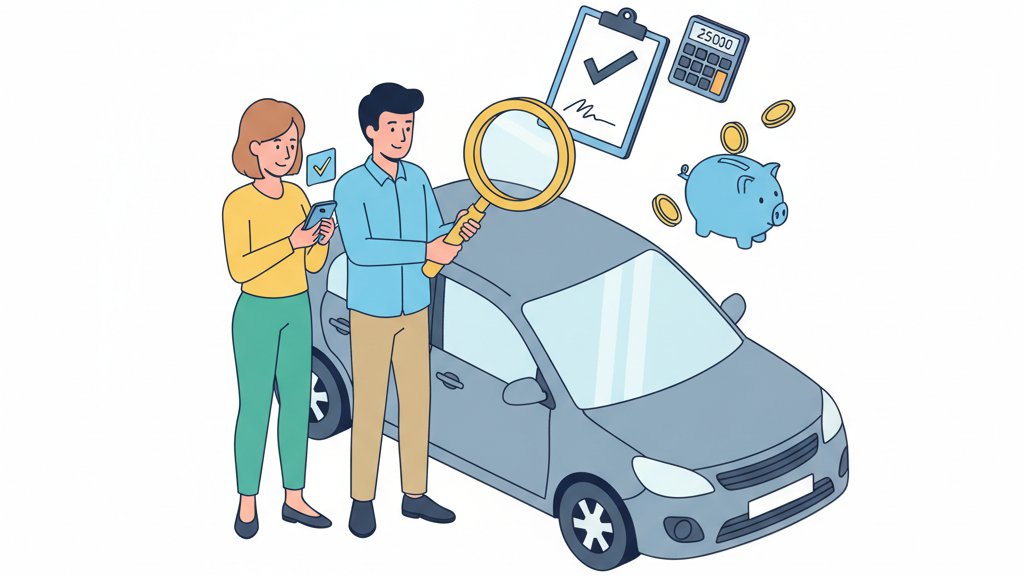
One of the biggest mistakes buyers make is focusing solely on the monthly payment. To understand how to buy a used car guide effectively, you must look at the “Total Cost of Ownership.” In the U.S., the average used car price is currently hovering around $25,000 to $27,000, but the price you negotiate is just the starting point for your bank account. If your budget is tight, you might look for the cheapest car lease deals as an alternative to buying used.
| Purchase Scenario | Sticker Price | Interest Rate (APR) | Term Length | Total Interest Paid |
|---|---|---|---|---|
| Excellent Credit (750+) | $20,000 | 6.5% | 48 Months | $2,746 |
| Average Credit (670-739) | $20,000 | 9.0% | 48 Months | $3,865 |
| Subprime Credit (<600) | $20,000 | 18.0% | 48 Months | $8,150 |
Understanding Dealer Fees, Sales Tax, and Registration Costs
When you sit down at the finance and insurance (F&I) office, expect to see several line items. Documentation fees (Doc Fees) vary by state; for example, Florida has no cap and dealers often charge $700+, while California caps them at $85. You must also account for state sales tax (averaging 5% to 9% in most states) and title/registration fees. Always ask for a “Buyer’s Order” before agreeing to a deal to see these costs itemized clearly.
The Hidden Impact of Interest Rates on Your Monthly Payment
Interest rates on used cars are typically 2% to 5% higher than on new cars. Much like the fluctuations seen with a mortgage rate cap in the housing market, auto loan rates can significantly impact your long-term costs. Currently, a buyer with a “Good” credit score (700-749) might see rates around 7% to 9%, while “Subprime” buyers (below 600) could face staggering rates of 18% to 21%. Over a 60-month loan, the difference between a 7% and 18% rate on a $20,000 loan is over $6,500 in interest alone—enough to buy a second, older car.
Example: Borrowing $15,000 at 8.5% APR for 60 months results in a monthly payment of $307.78 and a total repayment of $18,466.80—meaning you pay $3,466.80 just for the privilege of borrowing.
Factoring in Post-Purchase Costs: Insurance, Maintenance, and Fuel
A used BMW might have the same sticker price as a newer Honda, but the maintenance costs will be vastly different. Budget at least $100 per month for a “sinking fund” to cover tires, oil changes, and unexpected repairs. Additionally, call your insurance agent with the VIN of the car you are considering before you buy; insurance premiums for certain models or younger drivers can add $150+ to your monthly overhead.
How to Inspect and Verify a Used Vehicle Like a Pro
Never take a seller’s word for the condition of the vehicle. Mechanical issues are often hidden under a freshly detailed engine bay. Your goal in this phase of the how to buy a used car guide is to find reasons *not* to buy the car, which gives you leverage or protects you from a bad investment.
- Check the Tires: Uneven wear suggests alignment or suspension issues.
- Inspect Fluids: Dark, burnt-smelling oil or cloudy coolant are major red flags.
- Verify Electronics: Test every window, lock, and climate control setting.
- Look for Overspray: Paint on rubber seals indicates a previous accident and cheap repair.
The Essential Pre-Purchase Inspection (PPI) Checklist
Spend the $150 to $250 to have an independent mechanic perform a Pre-Purchase Inspection. They will put the car on a lift to check for frame damage, fluid leaks, and suspension wear that you cannot see from the curb. If a dealer or private seller refuses to let you take the car to your own mechanic, walk away immediately—this is the single biggest red flag in used car sales.
Decoding the Vehicle History Report: Carfax and AutoCheck
A Vehicle History Report (VHR) is mandatory. It tracks the car’s life through VIN records. Look for “Regular Maintenance” entries, which show the previous owner cared for the vehicle. Be wary of “Structural Damage,” “Airbag Deployment,” or “Odometer Discrepancy” flags. Also, check the number of previous owners; a car that has changed hands five times in three years likely has a recurring problem that no one can fix.
Financing Your Purchase: Finding the Best Rates
Many buyers make the mistake of “payment shopping” at the dealership. This allows the dealer to hide high interest rates by stretching the loan term to 72 or 84 months. Instead, you should secure your financing before you ever step foot on a lot.
Important: Always secure a pre-approval letter from your bank or credit union before visiting a dealership. This prevents the dealer from marking up your interest rate for extra profit.
Comparing Credit Union Loans, Bank Financing, and Dealer Credit
Local credit unions almost always offer the most competitive used car rates in the U.S., often 1% to 2% lower than national banks. Dealer financing is “indirect,” meaning the dealer sends your info to several banks and often adds a “markup” to the rate they receive. If the bank approves you for 6%, the dealer might tell you the best rate is 8%, pocketing the 2% difference as profit.
Smart Alternatives to Traditional Car Loans
Borrowing isn’t always the best path. In a high-interest-rate environment, avoiding debt can be the smartest financial move you make. Explore these alternatives to keep your balance sheet clean and your stress levels low.
- Private Sale of Current Assets: Selling electronics, furniture, or an old vehicle to increase your down payment.
- Employer Salary Advances: Some HR departments offer interest-free advances for reliable transportation.
- Family Loans: A private agreement with a family member can bypass high bank interest rates.
- Credit Counseling: If you are buying a car because your old one was repossessed, contact a non-profit debt counselor first.
Common Used Car Myths and Mistakes to Avoid
The used car market is full of outdated advice. One common myth is that you should always buy at the end of the month to get a “desperate” salesperson. While quotas exist, a good car at a fair price will sell any day of the week. Focus on the data, not the timing.
Myth: Low Mileage Always Means a Better Vehicle
A 10-year-old car with only 20,000 miles may have dry-rotted seals and gaskets from sitting idle. Conversely, a 3-year-old car with 60,000 highway miles that was serviced every 5,000 miles might be in much better mechanical shape. Look for service records over odometer readings.
The Mistake of Monthly Payment Shopping Instead of Total Price
Practical Scenario: A salesperson offers you a “comfortable” payment of $350/month. On a $18,000 car, they might achieve this by stretching the loan to 84 months. By the time the loan is paid off, the car is 12 years old, likely needs a new transmission, and you have paid nearly $30,000 for an $18,000 vehicle. If you’re looking for extra income to cover these costs, there are plenty of side hustles to make extra money available today.
FAQ: How Do I Spot a Flood-Damaged or Salvage Title Vehicle?
Check for a musty smell in the interior, look for silt or sand in the spare tire well, and check for rusted screw heads under the dashboard. Use the NICB’s VinylCheck (a free service) to see if the car has been declared a total loss. A salvage title vehicle is worth about 50% less than a clean title equivalent and can be very difficult to insure or finance.
The most expensive mistake you can make is walking onto a car lot without a pre-approval letter and a professional inspection report in hand. Secure your financing at a credit union first, then let the data—not the salesperson—dictate the final price you are willing to pay.

Great guide, really helpful stuff. I recently went through this process and managed to get a good deal, but it was a real nail-biter. My biggest hurdle was getting a decent loan rate from a dealership. Did anyone else find it tricky to get pre-approved for a loan through a credit union that was actually competitive?
Hi Michael, that’s a common challenge. Securing pre-approval from a credit union is often a great starting point because they tend to offer more favorable rates than dealerships. Always shop around and compare offers, and don’t be afraid to leverage one offer against another if you have multiple pre-approvals.
This is so timely! I’ve been looking at used cars for weeks now and the whole ‘out-the-door’ price point is something I’d completely overlooked. I was just focusing on the sticker price, which seems so naive now. Thank you for breaking down the steps so clearly; it’s making the process feel much less overwhelming.
I was comparing a few models last year and the maintenance costs were definitely a surprise. Some cars that looked affordable upfront ended up being way more expensive long-term. This guide really emphasizes the total cost of ownership, which is vital. One thing I’m still a bit fuzzy on is how to best verify a VIN history; are there any specific services you’d recommend over others?
Thanks Olivia! Verifying VIN history is crucial. While there are several services available, reputable ones like Carfax or AutoCheck offer comprehensive reports that include accident history, title issues, and odometer readings. It’s a small investment that can prevent a huge headache down the road.
This is a really comprehensive guide. I’m currently in the market for a used car and have been feeling a bit overwhelmed by all the steps. That point about determining the ‘out-the-door’ price is crucial; I always forget to factor in all those hidden fees. I’ll definitely be re-reading this before I head to the dealership.
Great article! I was comparing a few models last month and the maintenance cost prediction was a huge factor. My old car was a nightmare with repairs. One thing I’m still a bit fuzzy on is the VIN history verification – are there any specific services you recommend checking beyond just a basic VIN lookup? I want to make sure I’m not missing any red flags.
Hi Andrew, great question. While we can’t recommend specific third-party services, we advise looking for comprehensive reports that include accident history, title issues like salvage or flood damage, and odometer readings. Transparency is key!
Spot on with the pre-approval from a credit union. I found that getting that sorted *before* I even started looking gave me a lot more leverage when it came to negotiating. Also, don’t underestimate the power of a really thorough test drive, not just around the block but on different road surfaces if possible.
I agree with most of your points, but I think the article could put a little more emphasis on the actual negotiation. Sometimes, even with all your homework, sellers try to pressure you. I learned that the hard way when I bought my first car and ended up paying way too much because I wasn’t confident enough to walk away. My advice is to have your absolute maximum price in mind and stick to it. 🙅
You’re absolutely right, Robert. Negotiation is a critical skill, and having a firm walk-away price is essential. Building that confidence comes with preparation and remembering your ultimate budget. Thanks for sharing your valuable experience!