

Definition
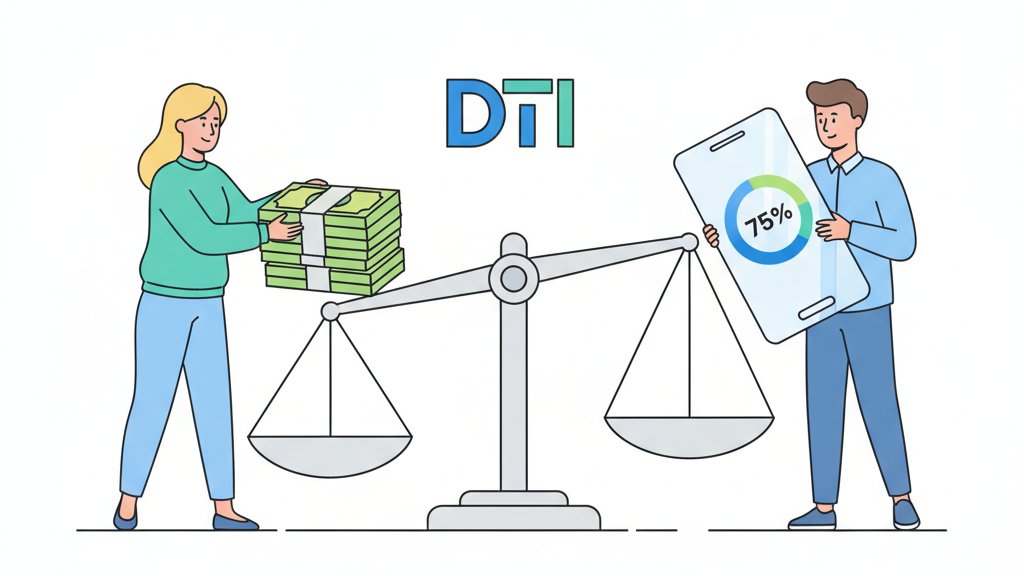
debt-to-income ratio — The debt-to-income (DTI) ratio is a financial metric that compares an individual’s monthly debt payments to their gross monthly income. It is a critical tool used by lenders to assess a borrower’s ability to manage monthly payments and repay borrowed money.
How debt-to-income ratio works
The debt-to-income ratio is a simple but powerful mathematical formula. From my years working at Nordea and Handelsbanken, I can tell you that this is often the very first “filter” a bank applies when you submit a loan application. It essentially measures the “breathing room” in your budget. To calculate it, you divide your total monthly debt obligations by your gross monthly income (your pay before taxes and deductions). The result is expressed as a percentage.
Lenders generally divide DTI into two categories: “front-end” and “back-end.” The front-end ratio focuses solely on housing costs, such as mortgage payments, property taxes, and insurance. The back-end ratio—which is what most people mean when they say “DTI”—includes all recurring debt payments, such as personal loans, credit card minimums, student loans, and car payments. For most traditional lenders, a back-end ratio of 36% to 43% is the upper limit for approving a standard mortgage.
Let’s look at a practical numerical example. Imagine Sarah earns $6,000 per month in gross income. Her monthly expenses include a $1,500 mortgage payment, a $300 car loan, and $200 in credit card minimum payments. Her total monthly debt is $2,000. To find her DTI, we divide $2,000 by $6,000, which equals 0.333, or a 33% debt-to-income ratio. Because this is below the 36% threshold, Sarah is viewed as a lower-risk borrower and is more likely to secure favorable terms when she chooses to compare mortgage rates for a new property.
Advantages and disadvantages
Understanding your DTI ratio is not just for the bank’s benefit; it is a vital health check for your own finances. However, like any financial metric, it has its strengths and limitations. Below is a breakdown of the pros and cons of relying on DTI as a measure of financial stability.
| Advantages | Disadvantages |
|---|---|
| Objective Assessment: It provides a clear, numerical snapshot of your financial obligations relative to your earnings. | Ignores Cost of Living: DTI doesn’t account for essential expenses like groceries, utilities, or childcare, which vary by location. |
| Risk Management: Helps prevent over-borrowing by setting a ceiling on how much debt you can realistically handle. | Gross vs. Net Discrepancy: Since it uses gross income, it doesn’t reflect the actual “take-home” pay available after taxes. |
| Predictive Power: Statistically, borrowers with lower DTIs are significantly less likely to default on their loans. | Asset Oversight: A person with high DTI but millions in savings might still be a low-risk borrower, but DTI alone won’t show that. |
While the DTI is a standard industry benchmark, I always advise clients to look deeper. A 40% DTI might be manageable for a high-earner with $20,000 gross monthly income because the remaining 60% ($12,000) covers lifestyle costs easily. However, for someone earning $3,000, a 40% DTI leaves only $1,800 for everything else, which can be a very tight squeeze in today’s economy.
debt-to-income ratio in practice
In the real world, your DTI ratio dictates the “price” of your money. If you have a high DTI, lenders view you as a higher risk. This often leads to higher interest rates or outright rejections. If you are planning to apply for unsecured personal loans online, you should aim to keep your DTI below 35% to ensure you get the fastest approval and the lowest possible rates.
If you find that your DTI is creeping toward the 45-50% range, it is time to take corrective action. You can improve this ratio in two ways: increasing your gross income or decreasing your monthly debt payments. Often, the most effective strategy is a “debt snowball” or “debt avalanche” method to pay off smaller balances, which immediately lowers your monthly debt obligation and improves your DTI percentage.
When searching for the best personal loan lenders, keep in mind that they will look at your DTI as a sign of your “capacity.” Capacity is one of the “Five Cs of Credit.” Even if you have a perfect credit score, a high DTI can prevent you from getting a loan because it shows you simply don’t have enough cash flow to take on more debt. Conversely, if you are in a temporary cash crunch, you might look for no interest payday loans for very small amounts, but be extremely careful—these are short-term fixes and do not solve the underlying DTI issue.
My professional tip: Calculate your DTI every six months. It is a vital sign for your financial health, much like blood pressure is for your physical health. If it starts to rise, it’s an early warning signal to cut back on spending before you reach a point of financial distress.
Frequently asked questions about debt-to-income ratio
What is a “good” debt-to-income ratio?
Generally, a DTI of 36% or less is considered “good” by most financial institutions. Ratios between 37% and 49% are considered manageable but may lead to higher interest rates. Anything above 50% is a red flag, indicating that more than half of your income is already spoken for, leaving you very vulnerable to financial shocks.
Does my debt-to-income ratio affect my credit score?
Surprisingly, no. Your DTI ratio is not included in your credit report and does not directly calculate into your FICO or VantageScore. However, the amount of debt you owe (credit utilization) does affect your score, and lenders will look at both your credit score and your DTI separately when deciding whether to lend to you.
Can I get a mortgage with a high DTI?
Yes, it is possible, but it is more difficult and expensive. Some government-backed loans (like FHA loans in the US) allow for a DTI as high as 43% or even 50% in special cases. However, you will likely pay a higher interest rate, and you may be required to have more significant cash reserves in the bank to offset the risk.