
Table of Contents
- What is a 365 Day Loan and How Does It Work?
- The Difference Between Short-Term Cash Advances and Year-Long Installment Loans
- Why Borrowers Choose 12-Month Repayment Terms
- Total Costs: Understanding APR, Interest, and Fees on a 1-Year Loan
- Example Calculation: The True Cost of Borrowing $2,000 for 365 Days
- Hidden Fees to Watch Out For: Origination, Late Payment, and Prepayment Penalties
- Eligibility Requirements for 365 Day Loans in the United States
- Can You Get a 12-Month Loan with Bad Credit?
- Comparing Your Options: Where to Find 365 Day Loans
- The Risks of Long-Term Small Dollar Credit
- Smarter Alternatives to High-Interest 12-Month Loans
- How to Safely Apply for a 365 Day Installment Loan
- Common Myths and Frequently Asked Questions
When an unexpected expense disrupts your budget, finding a middle ground between a high-pressure payday loan and a multi-year commitment can feel like an impossible balancing act. In this guide, we break down exactly how 365-day installment loans work, from the true cost of interest over a full year to the specific criteria lenders use to approve your application. Our team has analyzed current market rates and federal leading regulations to ensure you have the transparent, expert-backed information needed to make the safest financial choice for your situation.
What is a 365 Day Loan and How Does It Work?
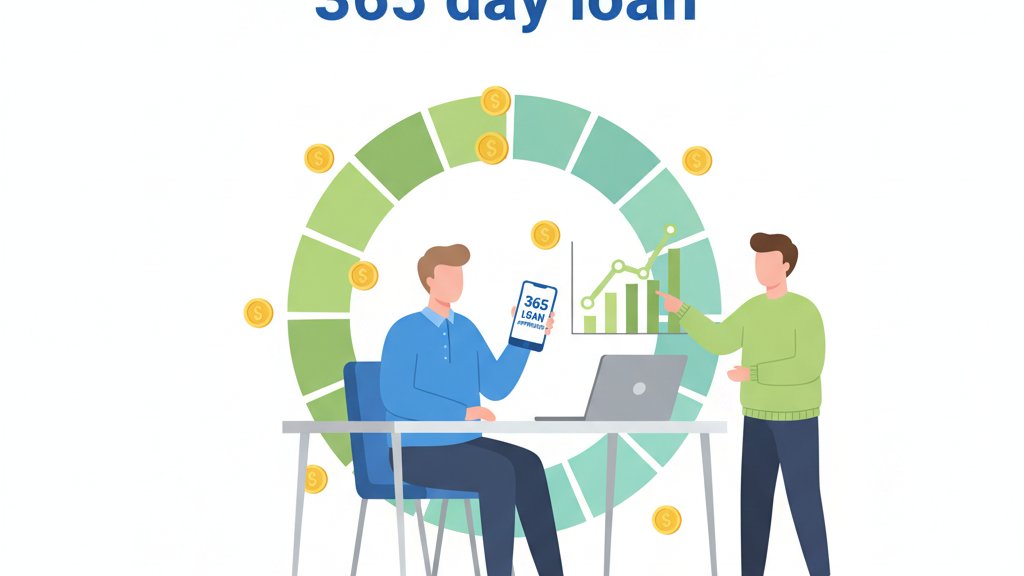
A 365 day loan is a type of personal installment loan designed to be repaid over exactly one year. Unlike traditional payday loans that demand full repayment within two to four weeks, this financial product spreads the principal and interest across 12 monthly installments. This structure is specifically intended to make the monthly obligation more manageable for borrowers who need to cover a significant expense—such as a major car repair or medical bill—without draining their entire next paycheck. For those looking for specific vehicle financing options, researching a mogo auto loan can provide a useful benchmark for installment-based lending.
The Difference Between Short-Term Cash Advances and Year-Long Installment Loans
The primary distinction lies in the “balloon payment” versus the “amortization schedule.” A standard cash advance requires you to pay back the total amount plus fees in one lump sum, often leading to a cycle of re-borrowing. In contrast, a 365 day loan uses an amortization schedule where each payment covers a portion of the interest and a portion of the principal. While you pay interest for a longer duration, the “sticker shock” of the monthly payment is significantly lower, providing better stability for your monthly cash flow.
Why Borrowers Choose 12-Month Repayment Terms
Borrowers typically gravitate toward the 12-month mark because it aligns perfectly with annual budgeting. It is a psychological and financial “sweet spot”: long enough to keep payments low, but short enough that the debt doesn’t linger for years. In the U.S. market, many online lenders offer these loans with fixed interest rates, meaning your payment on day 1 is exactly the same as your payment on day 365, allowing for precise long-term financial planning. If you are struggling with existing high-interest debt before taking a new loan, exploring various debt relief programs may be a more sustainable first step.
Total Costs: Understanding APR, Interest, and Fees on a 1-Year Loan

The cost of a 365 day loan is expressed through the Annual Percentage Rate (APR), which includes both the interest rate and any mandatory fees. In the United States, APRs for these loans can vary wildly based on your creditworthiness and state regulations. Prime borrowers might see APRs between 6% and 18%, while subprime “short-term” installment loans can carry APRs ranging from 36% to over 100%.
Example: Borrowing $1,000 at a 35% APR for 365 days results in 12 monthly payments of approximately $100.46, totaling $1,205.52 in repayments—a total cost of $205.52 in interest.
Example Calculation: The True Cost of Borrowing $2,000 for 365 Days
Let’s look at a concrete example. Suppose you borrow $2,000 at a 25% APR for a 12-month term. Your monthly payment would be approximately $189.92. Over the course of the 365 days, you would pay a total of $2,279.04. This means the “cost of credit” is $279.04. If you had taken the same loan at a 10% APR, your total interest would only be $110. This comparison highlights why shopping for even a 5% difference in APR can save you significant money over a full year. To better manage your future finances, it is also wise to compare a savings account interest rate to ensure your emergency fund is growing while you pay down debt.
Hidden Fees to Watch Out For: Origination, Late Payment, and Prepayment Penalties
Beyond interest, lenders often charge an origination fee—usually 1% to 8% of the loan amount—which is deducted from the cash you receive. For instance, on a $2,000 loan with a 5% origination fee, you only receive $1,900 but still owe interest on the full $2,000. Additionally, always verify that the lender does not charge a “prepayment penalty.” A borrower-friendly 365 day loan should allow you to pay off the balance early without extra charges, effectively shortening the loan and reducing the total interest paid.
Eligibility Requirements for 365 Day Loans in the United States
To qualify for a 12-month loan, U.S. lenders generally require you to be at least 18 years old, a legal resident or citizen, and have an active checking account for fund disbursement. Most online platforms use automated underwriting systems that look beyond just your FICO score. Before applying, it is helpful to check my uc credit report to ensure your financial history is accurate and ready for review.
- Proof of Income: Recent pay stubs, W-2s, or 1099 forms
- Active Checking Account: For Direct Deposit and automated ACH repayments
- Valid Identification: Government-issued ID (Driver’s License or Passport)
- Debt-to-Income Ratio: Typically must be below 40-45%
Can You Get a 12-Month Loan with Bad Credit?
Yes, but it comes at a price. Lenders specializing in “bad credit installment loans” focus more on your employment stability than your past credit mistakes. If your score is below 580, you should expect APRs at the higher end of the spectrum (36%+). To improve your chances, ensure you have no recent bankruptcies or outstanding collections from other short-term lenders, as these are major red flags even for subprime lenders.
Comparing Your Options: Where to Find 365 Day Loans
Not all 365 day loans are created equal. Where you apply dictates the speed of funding and the interest rate you’ll receive. Below is a comparison of common lending avenues in the U.S. market:
| Lender Type | Typical APR Range | Funding Speed | Best For |
|---|---|---|---|
| Credit Union (PAL) | Max 28% | 1-3 Days | Small amounts, low cost |
| Online Lenders (e.g., Upstart) | 6% – 36% | 24-48 Hours | Speed and fair credit |
| Traditional Banks | 5% – 15% | 3-7 Days | Excellent credit history |
The Risks of Long-Term Small Dollar Credit
While a year-long term feels manageable, it can be a double-edged sword. The primary risk is the total cost of borrowing. A $1,000 loan with a high APR might have a tiny monthly payment, but by the end of the 365 days, you may have paid back nearly double what you borrowed. It is easy to lose track of the “total price” when focusing only on the “monthly price.”
Important: Always check if your lender reports to Experian, Equifax, and TransUnion. While on-time payments help your score, a single missed payment on a 365-day schedule can drop your score by over 100 points. If you are looking to reduce monthly overhead to avoid loans altogether, reading simple energy reviews can help you find ways to lower your utility bills.
Smarter Alternatives to High-Interest 12-Month Loans
Before committing to a 365 day loan, I always advise my readers to look at “non-loan” solutions. These options often have zero interest and won’t impact your credit score. Even if they only cover half of your financial need, they reduce the amount you need to borrow, saving you interest costs immediately.
Practical Example: Sarah needs $1,200 for a car transmission. Instead of a high-interest loan, she gets a $400 advance from her employer via an app, sells an old laptop for $300, and only borrows $500 through a 12-month loan. This strategy saves her over $150 in interest charges compared to borrowing the full amount.
How to Safely Apply for a 365 Day Installment Loan
To secure the best rates and avoid predatory practices, follow this step-by-step process:
- Check Your Credit Score: Know your starting point to filter out lenders you won’t qualify for.
- Prequalify Online: Use platforms that offer “soft” credit pulls to see estimated rates.
- Compare the APR, not just the monthly payment: This reveals the true cost of the loan.
- Read the Fine Print: Specifically look for “origination fees” and “prepayment penalties.”
- Verify State Licensing: Ensure the lender is legally authorized to lend in your state.
Common Myths and Frequently Asked Questions
Is a 365 Day Loan the Same as a Payday Loan? Technically, no. Payday loans are characterized by short terms (usually 14 days) and “triple-digit” APRs (often 400%+). A 365 day loan is an installment loan. While both can be expensive, the installment loan is generally considered safer because it provides a clear path to debt elimination through scheduled, predictable payments.
Can I Pay Off a 1-Year Loan Early to Save on Interest? In most cases, yes. Most modern online lenders use “simple interest,” which is calculated daily based on your remaining principal. If you get a tax refund or a bonus at work and pay off the loan on day 180 instead of day 365, you will save all the interest that would have accrued in the second half of the year.
Before you sign a 365 day loan agreement, always compare the total repayment amount—not just the monthly payment—against your budget to ensure you aren’t overpaying for the convenience of time. My final advice: prioritize lenders that allow early repayment without penalties, as this gives you the flexibility to kill the debt faster and save significantly on interest costs.
Read more about related topics
- Spectrum Internet Reviews: Real Customer Experiences and Ratings
- Affordable Insurance Companies: Find Quality Coverage on Any Budget
- Whole Life Insurance: Your Complete Guide to Lifelong Coverage
- Con Edison Reviews: Real Customer Experiences and Service Ratings
- Aktsam Car Insurance Reviews: Real Customer Experiences & Ratings
- Debt Free Money Bank: How to Build Wealth Without Borrowing

This is super helpful! I was comparing payday loans to longer-term options last month and honestly, the fees on payday loans were terrifying. Knowing there’s a middle ground like a 365-day loan is a huge relief for unexpected emergencies.
Thanks for breaking down the amortization schedule versus balloon payments. That’s always been a confusing point for me. My main question is, what are the typical credit score ranges lenders look for when approving these 365-day loans? I’ve got a decent score, but I’m not sure if it’s high enough.
Hi Andrew, that’s a great question! While credit score requirements can vary by lender, generally, lenders for 365-day installment loans are looking for borrowers with fair to good credit, typically in the 600-700 range. However, some lenders may be more flexible, especially if you have a stable income. It’s always worth checking specific lender criteria.
I found this really informative, especially the section on the true cost of interest over a year. It’s easy to get caught up in the monthly payment and forget the total amount paid. One tip I’d add is to always attempt to pay a little extra each month if possible, even a small amount can chip away at the principal faster. 👍