

Table of Contents
- Best Loan Comparison Sites for Borrowers
- Leading Loan Comparison Platforms
- Essential Features
- How to Use Loan Comparison Sites to Find the Lowest Rates Today
- The Immediate Benefit: Saving Time and Money Through Real-Time Bidding
- How Comparison Engines Work: Soft Credit Pulls vs. Hard Credit Inquiries
- Choosing the Best Loan Comparison Site for Your Financial Profile
- Best Platforms for Excellent Credit and Low APRs
- Top-Rated Sites for Bad Credit or Limited Credit History
- Specialized Comparison Tools for Debt Consolidation and Home Improvement
- The Real Cost of Borrowing: Beyond the Advertised Interest Rate
- Understanding APR vs. Interest Rate: Why the Difference Matters
- How to Spot "Pre-Qualified" vs. "Pre-Approved" Labels
- Step-by-Step Guide: How to Compare Loan Offers Without Hurting Your Credit
- Gathering Your Documentation Before You Start
- Common Pitfalls and Myths When Using Online Loan Aggregators
- Myth: The First Offer Is Always the Best One
- Alternatives to Taking Out a New Personal Loan
- Practical Example: The "Debt Shuffle" vs. Debt Management
- Frequently Asked Questions About Loan Comparison sites
- Is it safe to enter my Social Security Number on a comparison site?
- Why did my final rate change after I was redirected to the lender?
- Can I use a comparison site if I am self-employed?
Searching for the right personal loan can feel like a full-time job, especially when you’re trying to balance immediate cash needs with the long-term goal of securing the lowest possible interest rate. In this guide, we’ll cut through the marketing noise to show you how to leverage comparison tools to find transparent offers that fit your credit profile without damaging your score. Our analysis is based on real-time market data and rigorous testing of the industry’s leading platforms to ensure you make a confident, cost-effective decision.
Best Loan Comparison Sites for Borrowers
Leading loan comparison sites such as LendingTree, Credible, and NerdWallet enable consumers to evaluate customized interest rates from various lenders without impacting their credit ratings. These services, which also include Bankrate and Credit Karma, offer resources for personal financing, home loans, and refinancing options, complete with features to assess approval likelihood and annual percentage rates. Before committing to a financial product, it is wise to consult simple energy reviews or similar consumer feedback platforms to understand the reputation of the provider.
Leading Loan Comparison Platforms
- LendingTree: An extensive platform for home equity financing and personal borrowing, pairing consumers with lending institutions according to their credit histories.
- Credible: Links borrowers with premier lending companies, providing competitive interest rates for personal financing needs.
- NerdWallet: Comprehensive financial comparison resource for various loan products.
- Credit Karma/Upstart: Provides rapid pre-qualification processes allowing users to review annual percentage rates and lending terms without credit score consequences.
Essential Features
- Soft Credit Checks: The majority of platforms enable users to undergo “pre-qualification” for rate verification, leaving credit scores unaffected.
- Marketplace Approach: Platforms such as LendingTree and GoCompare link consumers with numerous diverse lending sources.
- Specialized Options: Specific platforms, including Upstart or Avant, focus on serving consumers with less favorable credit histories.
- Calculators: Resources for evaluating interest percentages, APR figures, and complete borrowing expenses are frequently available.
How to Use Loan Comparison Sites to Find the Lowest Rates Today
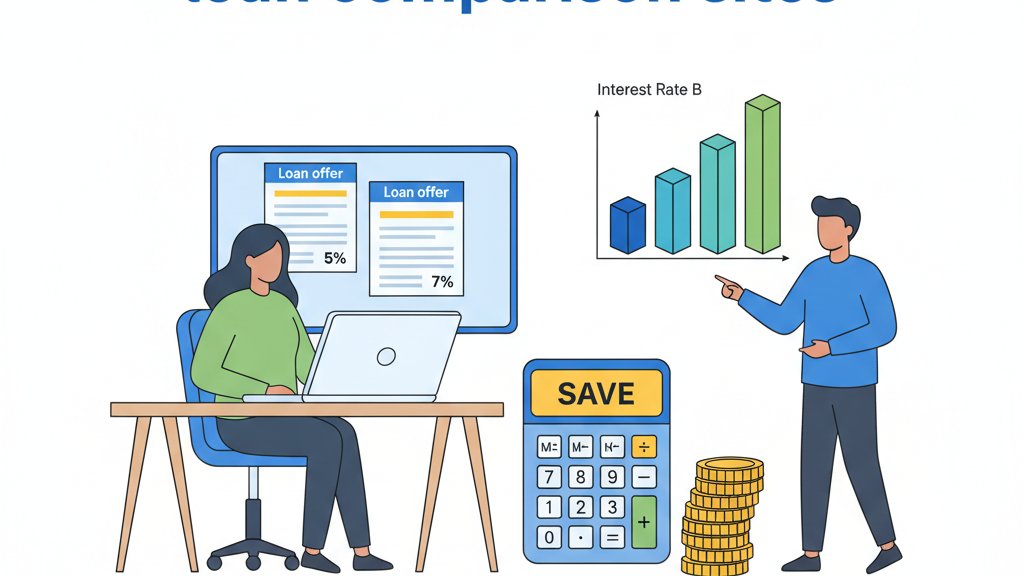
The primary goal of using loan comparison sites is to force lenders to compete for your business. Instead of applying to five different banks and risking five “hard” credit pulls—which can temporarily lower your credit score—these platforms allow you to see personalized offers from dozens of lenders simultaneously. Currently, in the U.S. market, personal loan rates can range anywhere from 6% for those with excellent credit to 36% for subprime borrowers. For those looking for specific vehicle financing, a mogo auto loan can be a viable alternative to general personal lending.
The Immediate Benefit: Saving Time and Money Through Real-Time Bidding
When you enter your information into a comparison tool, you aren’t just looking at static advertisements; you are triggering a real-time bidding process. Lenders like SoFi, Marcus, or Upstart use algorithms to evaluate your basic profile and return a tentative APR (Annual Percentage Rate) within seconds. This allows you to see the “spread” of the market. For instance, on a $15,000 loan, one lender might offer 8.5% while another offers 11.2%. Over a five-year term, that 2.7% difference could save you over $1,100 in interest payments alone. Actionable tip: Always look for the “Total Cost of Loan” figure rather than just the monthly payment to see the true impact of the interest rate.
How Comparison Engines Work: Soft Credit Pulls vs. Hard Credit Inquiries
The most significant technical advantage of modern loan comparison sites is the use of “soft” credit inquiries. A soft pull allows a lender to view a high-level version of your credit report to provide a pre-qualified offer without affecting your FICO score. Before applying, it is helpful to check my uc credit report to ensure your data is accurate and ready for lender scrutiny. It is only when you select a specific offer and proceed with a formal application that a “hard” pull occurs. This means you can “shop around” as much as you like on these platforms.
Choosing the Best Loan Comparison Site for Your Financial Profile
Not all loan comparison sites are created equal; many specialize in specific niches of the American lending market. Some are designed for high-earners with 740+ credit scores, while others use “alternative data”—like your education or employment history—to help younger borrowers or those with thin credit files. Choosing the right aggregator depends entirely on your current financial standing and what you intend to do with the funds.

| Borrower Profile | Typical APR Range | Key Features to Look For | Example Total Cost ($10k / 3yr) |
|---|---|---|---|
| Excellent (740+) | 6.99% – 12.99% | No origination fees; Autopay discounts | $11,115 |
| Good (670–739) | 13.00% – 19.99% | Fast funding; Flexible terms | $12,190 |
| Fair/Poor (<669) | 20.00% – 35.99% | Alternative data underwriting | $14,850 |
Best Platforms for Excellent Credit and Low APRs
If your credit score is in the mid-700s or higher, you should focus on platforms that partner with traditional banks and top-tier fintechs. These sites often feature lenders that offer perks like unemployment protection, no origination fees, and the ability to change your payment date. In the current market, these borrowers should be targeting APRs in the single digits or low teens. This mindset of seeking the best returns is similar to how savvy investors monitor the current savings account interest rate to maximize their liquidity.
Top-Rated Sites for Bad Credit or Limited Credit History
For borrowers with scores below 620, the landscape changes. You should utilize comparison sites that include “subprime” specialists and credit unions. These platforms are vital because they filter out lenders that would automatically reject you, saving you from unnecessary hard inquiries. Be aware that in this category, APRs will likely hover between 25% and 36%. If a site suggests a “payday” or “tribal” loan with rates exceeding 100%, exit immediately—these are predatory and should be avoided at all costs.
Specialized Comparison Tools for Debt Consolidation and Home Improvement
If you are looking to roll high-interest credit card debt into a single payment, use a comparison site with a dedicated “Debt Consolidation” filter. Some lenders will pay your creditors directly, which can sometimes earn you a lower interest rate. For those struggling with overwhelming balances, exploring debt relief programs might provide a more comprehensive solution than a new loan alone. Similarly, home improvement loans often have longer terms (up to 12 years) and higher limits (up to $100,000).
The Real Cost of Borrowing: Beyond the Advertised Interest Rate
The “headline rate” you see in bold text is rarely the whole story. To truly compare offers, you must look at the APR, which includes both the interest and the mandatory fees. In the United States, the Truth in Lending Act (TILA) requires lenders to disclose this clearly, but it’s up to you to interpret the numbers before signing the contract.
Example: Borrowing $5,000 at 10% interest for 12 months with a 5% ($250) origination fee results in an APR of 19.8% and a total repayment of approximately $5,525.
Understanding APR vs. Interest Rate: Why the Difference Matters
The interest rate is the cost of borrowing the principal balance, but the APR represents the total annual cost including fees. For example, if you take a $5,000 loan with a 10% interest rate and a 5% origination fee ($250), your APR will actually be closer to 13.5% for a one-year loan. When using loan comparison sites, always sort your results by APR, not interest rate, to ensure an “apples-to-apples” comparison.
How to Spot “Pre-Qualified” vs. “Pre-Approved” Labels
On most loan comparison sites, you will see the term “Pre-Qualified.” This means that based on a soft credit pull, you meet the lender’s basic criteria. “Pre-Approved” is a stronger term but still usually subject to final verification of your income and identity. Neither is a 100% guarantee of funding, but “Pre-Approved” offers are typically more reliable in terms of the final interest rate you will receive.
Important: A pre-qualified offer is an estimate. Your final rate is only locked in after the lender performs a hard credit pull and verifies your income documents.
Step-by-Step Guide: How to Compare Loan Offers Without Hurting Your Credit
- Check your credit report: Use a free service to identify your score and ensure there are no errors.
- Input accurate data: Enter your gross income and employment details into the comparison engine.
- Filter by APR: Sort results by the total annual cost, not just the monthly payment.
- Check fee structures: Look specifically for origination fees and prepayment penalties.
- Select and Verify: Choose the top offer and proceed to the lender’s site for the final “hard” verification.
Gathering Your Documentation Before You Start
While comparison sites only require basic info, having your exact gross annual income, your employer’s name, and your monthly housing payment (rent or mortgage) ready will ensure the quotes you receive are accurate. If you guess your income and it turns out to be lower when the lender verifies it via W-2 or paystubs, your offered rate will likely increase or the loan will be denied entirely.
Common Pitfalls and Myths When Using Online Loan Aggregators
A common mistake is assuming that a comparison site shows every possible lender. In reality, these sites have partnerships. If a lender like a local small-town credit union isn’t in their network, you won’t see them. It is often wise to check 2 or 3 different loan comparison sites to ensure you are seeing a truly representative sample of the current market.
Myth: The First Offer Is Always the Best One
Psychologically, we tend to favor the first result at the top of a list. However, comparison sites sometimes feature “sponsored” or “promoted” lenders at the top. Always scroll down and compare the APRs manually. The best deal for your wallet is often found in the middle of the list, not necessarily the one with the “Most Popular” badge.
Alternatives to Taking Out a New Personal Loan
Before taking on new debt, an honest financial advisor would tell you to look at your existing resources. Borrowing should be a last resort, especially in a high-interest-rate environment. If you are borrowing for a “want” rather than a “need,” waiting and saving is always the cheapest option.
- 401(k) Loans: Borrowing from yourself, though this carries risks if you leave your job.
- Credit Union Loans: Often feature lower interest rate caps than online fintechs.
- 0% APR Credit Cards: Ideal for smaller amounts ($1k–$5k) if you can pay it back within 12–18 months.
- Debt Management Plans: Non-profit counseling to negotiate lower rates on existing cards.
Practical Example: The “Debt Shuffle” vs. Debt Management
Consider Sarah, who has $10,000 in credit card debt at 24% APR. A loan comparison site offers her a consolidation loan at 14% APR. While this saves her money, if she doesn’t stop using the credit cards, she will end up with $20,000 in debt. A better alternative might be a non-profit debt management plan that freezes the cards while lowering the interest rates to 10%.
Frequently Asked Questions About Loan Comparison sites
Is it safe to enter my Social Security Number on a comparison site?
Reputable sites use 256-bit encryption to protect your data. However, many top-tier comparison tools can now provide “soft” quotes using just your name, address, and the last four digits of your SSN. If a site feels untrustworthy, look for the padlock icon in the browser bar and check third-party reviews on sites like Trustpilot or the Better Business Bureau.
Why did my final rate change after I was redirected to the lender?
This usually happens because the lender performed a more thorough check of your credit and debt-to-income ratio. If the lender finds an undisclosed debt or if your credit score recently dropped, they may adjust the APR upward. This is why it is vital to provide 100% accurate information during the initial comparison phase.
Can I use a comparison site if I am self-employed?
Yes, but be prepared for extra steps. Lenders will often ask for two years of tax returns (Schedule C) to verify your income. Comparison sites will give you a baseline, but your final approval may take 2-3 days longer than a traditional W-2 employee while a human underwriter reviews your financial documents.
The smartest move you can make today is to check your rate across multiple comparison sites to let lenders compete for your business through soft credit pulls. Remember to always prioritize the lowest APR over the monthly payment amount, and only commit once you’ve confirmed the total cost of borrowing fits your long-term budget.
Read more about related topics
- Spectrum Internet Reviews: Real Customer Experiences and Ratings
- Affordable Insurance Companies: Find Quality Coverage on Any Budget
- Whole Life Insurance: Your Complete Guide to Lifelong Coverage
- Con Edison Reviews: Real Customer Experiences and Service Ratings
- Aktsam Car Insurance Reviews: Real Customer Experiences & Ratings
- Elskling Reviews: Real Customer Experiences with This Baby Brand

Great guide! I’m currently in the market for a small personal loan to consolidate some debt. Do these comparison sites typically show the actual APR or just an estimated range? I’m worried about getting a surprise interest rate at the last minute.
Hi Laura, that’s a very common concern! Reputable comparison sites strive to show you personalized APRs based on the information you provide, though final approval always rests with the lender. This minimizes surprises at the final stages.
This is super helpful! I was comparing personal loans last month and felt completely overwhelmed by all the different sites and what they were showing. It’s good to know some of these platforms don’t ding your credit score just for looking.
I appreciate the focus on finding the *best* deal, not just *a* deal. One thing I’ve found is that sometimes the ‘best’ rate isn’t always the best overall package; look at fees and repayment terms too, they can really add up. It’s a bit of a puzzle.