

Table of Contents
- How foreign transaction fees work
- Advantages and disadvantages of foreign transaction fees
- Foreign transaction fee in practice and practical tips
- Frequently asked questions about foreign transaction fee
- Is a foreign transaction fee the same as a currency conversion fee?
- How can I tell if my card charges a foreign transaction fee?
- Do I pay foreign transaction fees on international donations?
Definition
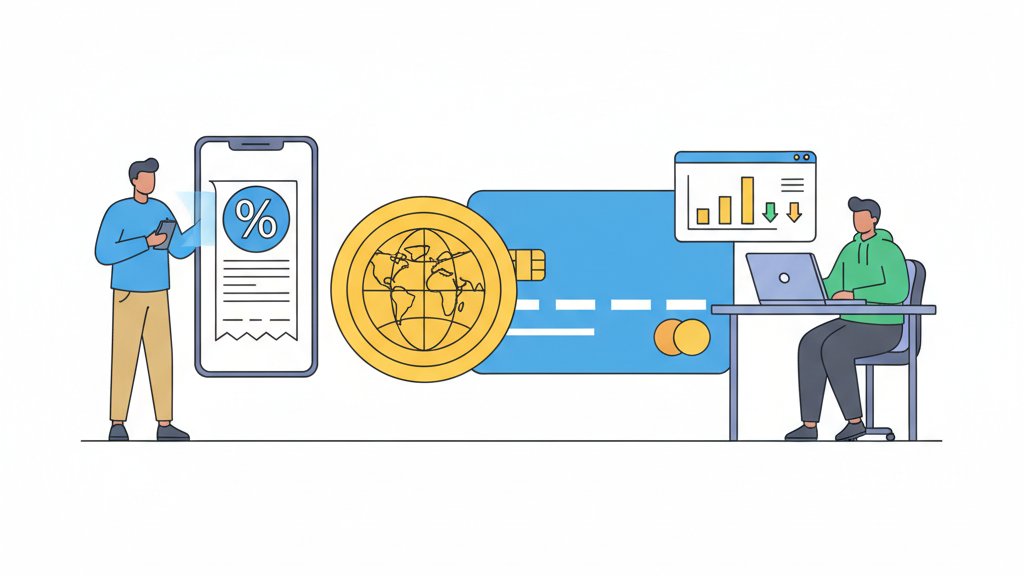
foreign transaction fee — A surcharge ranging from 1% to 3% levied by credit card issuers and payment networks on purchases made outside your home country or in a foreign currency. This fee covers the cost of processing transactions through international systems and converting the currency into your local denomination.
How foreign transaction fees work
A foreign transaction fee is essentially a convenience tax for using your credit or debit card internationally. When you swipe your card at a café in Paris or purchase a subscription from a company based in London, the transaction doesn’t just move through your local bank. It passes through a complex network involving the merchant’s bank, the payment network (like Visa or Mastercard), and finally your issuing bank. Each of these entities incurs costs for currency conversion and cross-border security, which are passed down to the consumer.
The fee is typically composed of two parts. First, the payment network (Visa or Mastercard) usually charges a 1% fee for its role in the global exchange. Second, the issuing bank (such as Chase, Citi, or Wells Fargo) often adds an additional 1% to 2% on top of that. While it might seem like a small percentage, these charges are applied to the total transaction amount after the currency has been converted, meaning they can add up significantly over a long trip.
A practical numerical example:
Imagine you are on vacation and decide to buy a high-end watch in Switzerland priced at 1,000 CHF (Swiss Francs). If the current exchange rate is 1:1 for simplicity, the watch costs $1,000. If your credit card carries a 3% foreign transaction fee, the calculation looks like this:
- Purchase Price: $1,000.00
- Foreign Transaction Fee (3%): $30.00
- Total Charged to Statement: $1,030.00
In this scenario, you’ve paid an extra $30 just for the privilege of using your card. If you are using a specialized best travel credit card, this fee is often waived entirely, allowing you to pay exactly $1,000 for the watch.
Advantages and disadvantages of foreign transaction fees
While foreign transaction fees are generally viewed as a disadvantage for consumers, it is important to understand why they exist and how they compare to alternative methods of spending money abroad.
| Pros (Why banks use them) | Cons (Impact on consumers) |
|---|---|
| Covers the cost of currency conversion and international fraud protection. | Increases the total cost of every international purchase by 1% to 3%. |
| Supports the infrastructure of global payment networks like Visa and Mastercard. | Can be an unexpected “hidden” cost for travelers who haven’t read their card’s fine print. |
| Often cheaper than the high margins found at physical currency exchange kiosks. | Applies to online shopping with international merchants, even if you are at home. |
The primary disadvantage is the cumulative cost. For a family spending $5,000 on an international vacation, a 3% fee results in $150 in pure bank charges. However, a small “advantage” is that even with a 3% fee, using a credit card often provides a better exchange rate than exchanging physical cash at an airport, where margins can be as high as 10% to 15%.
Foreign transaction fee in practice and practical tips
Navigating international spending requires a bit of strategy. The most effective way to avoid these fees is to carry a card specifically designed for international use. Many premium cards, as well as those offered by fintech companies, have moved away from these charges to attract frequent flyers. You can manage your spending and monitor these charges in real-time using tools like the capital one mobile app, which is known for its transparent fee structures and easy-to-use travel features.
Another critical tip is to watch out for “Dynamic Currency Conversion” (DCC). When you are at a checkout counter abroad, the card machine might ask if you want to pay in “USD” or the “Local Currency.” Always choose the local currency. If you choose USD, the merchant’s bank performs the conversion at a terrible rate, and your own bank may still charge you a foreign transaction fee on top of that. By choosing the local currency, you ensure that your bank handles the conversion at the most competitive market rate.
If you are a frequent traveler, it is worth looking into the best travel credit card options on the market. These cards not only waive foreign transaction fees but also offer rewards that can be used for future trips. For those who drive frequently across borders, certain specialty cards like the shell gas credit card can be useful for domestic rewards, but you must check if they apply fees for gas purchases made in neighboring countries like Canada or Mexico.
Finally, remember that these fees apply to online shopping too. If you are using an airline shopping portal to earn miles, ensure the merchant you are buying from is based in your home country. If you buy from a UK-based store while sitting in New York, your bank will likely trigger a foreign transaction fee because the merchant is international.
Frequently asked questions about foreign transaction fee
Is a foreign transaction fee the same as a currency conversion fee?
Technically, no, though they are often grouped together. A currency conversion fee is charged by the payment network (Visa/Mastercard) for the actual exchange of money. A foreign transaction fee is the total surcharge applied by your bank, which usually includes that network fee plus an additional mark-up from the bank itself.
How can I tell if my card charges a foreign transaction fee?
You can find this information in your card’s “Terms and Conditions” under the “Fees” section, specifically the “Schumer Box” in the US. Look for the line item labeled “Foreign Transactions.” Alternatively, most modern banking apps, such as the capital one mobile app, will list your card’s benefits and fee schedule clearly in the settings.
Do I pay foreign transaction fees on international donations?
Yes, if you use a card with these fees to donate to an organization based outside your country. If you want to compare charities and maximize your impact, ensure you are either donating to a local branch or using a card that waives foreign fees so that 100% of your money goes to the cause rather than bank surcharges.